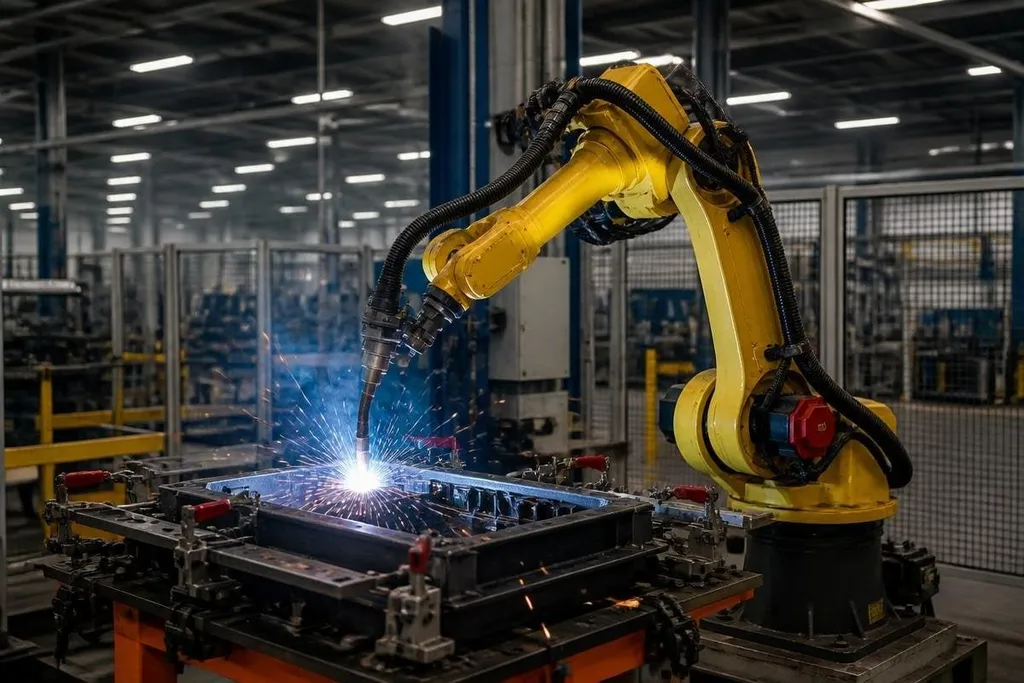
A factory robot can weld a joint, move a pallet, or check a part for defects without stopping for a shift change. That makes it useful wherever the same task repeats and a missed step costs time, scrap, or worker safety.
- Robots repeat fixed motions with steady timing.
- Sensors and cameras let newer systems react to changes on the line.
- The main limit is still the task: robots need clear rules, safe space, and regular care.
Repetition is where robots earn their place
Industrial robots work best when a factory asks for the same motion many times.
A six-axis arm can pick a part from a fixture, turn it, and place it in the next station. A welding robot can follow the same programmed path across a run of metal frames.
That repeatability helps the factory hold the same position and force from one part to the next. It also moves people away from hot, heavy, or awkward work. The benefit depends on the task staying stable enough for the robot to follow its program.
This is why robot use reaches beyond car plants. Factories use arms for palletizing, machine tending, painting, packaging, and inspection. Each job needs its own gripper, tool, program, and safety setup, so a robot arm alone doesn't finish the project.
Sensors make more tasks possible
Older robot cells often relied on fixed fixtures. The part arrived in one known position, and the arm followed the same path each time. Cameras, force sensors, and 3D scanners give newer cells more information before the arm moves.
A camera can check whether a part is present or turned the wrong way. A force sensor can feel contact during insertion, which helps when two parts need to fit together. A 3D scanner can measure a surface and send the result to an inspection system.
These tools don't make a robot independent in every setting. They help it handle a defined range of changes. Someone still has to set the limits, test failure cases, and decide when the cell must stop for a person.
A factory claim needs the robot, task, site, and date named beside it. Industrial robot reporting can give you those details before the next section tests where the limits appear.
The limits are practical
A robot needs space, power, guarding, and a clear way to stop. Its payload rating must cover the part, gripper, and any tool at the end of the arm. A larger load can reduce speed or require a different arm, floor mount, or safety design.
Programming also takes time. The factory must define the robot's path, set safe speeds, connect it to the programmable logic controller, and test the handoff between stations. A cell can run well after setup and still lose value if changeovers take too long.
Maintenance adds another cost. Motors, gearboxes, cables, grippers, cameras, and safety switches can all stop production when they fail. Spare parts and staff who can fix the cell matter as much as the arm's catalog price.
I'd skip a robot project when the task changes every few minutes and no one has mapped the handoffs around it. A person may be cheaper and faster for that work, even when the robot looks capable on paper.
Check the whole cell before buying
A useful review starts with the work around the robot. Check these points before you compare arm models:
- Name the task: Write down the part, motion, cycle time, and required quality.
- Measure the load: Include the gripper and tool in the payload calculation.
- Map the handoffs: Check how parts enter, leave, and recover after a failed pick.
- Plan safety: Mark fences, light curtains, emergency stops, and safe access points.
- Price the upkeep: Add training, spare parts, software, service, and lost time during setup.
That list keeps the decision tied to factory work instead of a robot's appearance or brochure language. It also shows where a simpler machine, a redesigned fixture, or a manual station may fit better.
Industrial robots are becoming more important because factories need repeatable work, safer handling, and better control of quality. The next useful measure is not how human an arm looks; it is how many good parts the full cell produces after setup, changeovers, stops, and repairs are counted.